contact@arkeotopia.org

Translation by F. Guichon and J.-O. Gransard-Desmond
Step 1. Discovering
Archaeological Remains
Exploring Uncharted Territories or How accidental discoveries are made
Corresponding pages in MAB1 and MAB2
MAB 1, p. 6 (step 1.3 of page 6 in the 1st edition) and MAB 2, pp. 6-7.
More about this step’s reference artifact
The drawing in My Archaeology Book titled Exploring Uncharted Territories was inspired by Tikal Temple I, located in the Tikal National Park of Northern Guatemala’s Petén province. This step illustrates the concept of an accidental discovery. This kind of discovery is not based on a scientific approach, but is rather a matter of luck. For this reason, there is not an archaeologist pictured in the drawing, but instead an explorer named Gaspard.
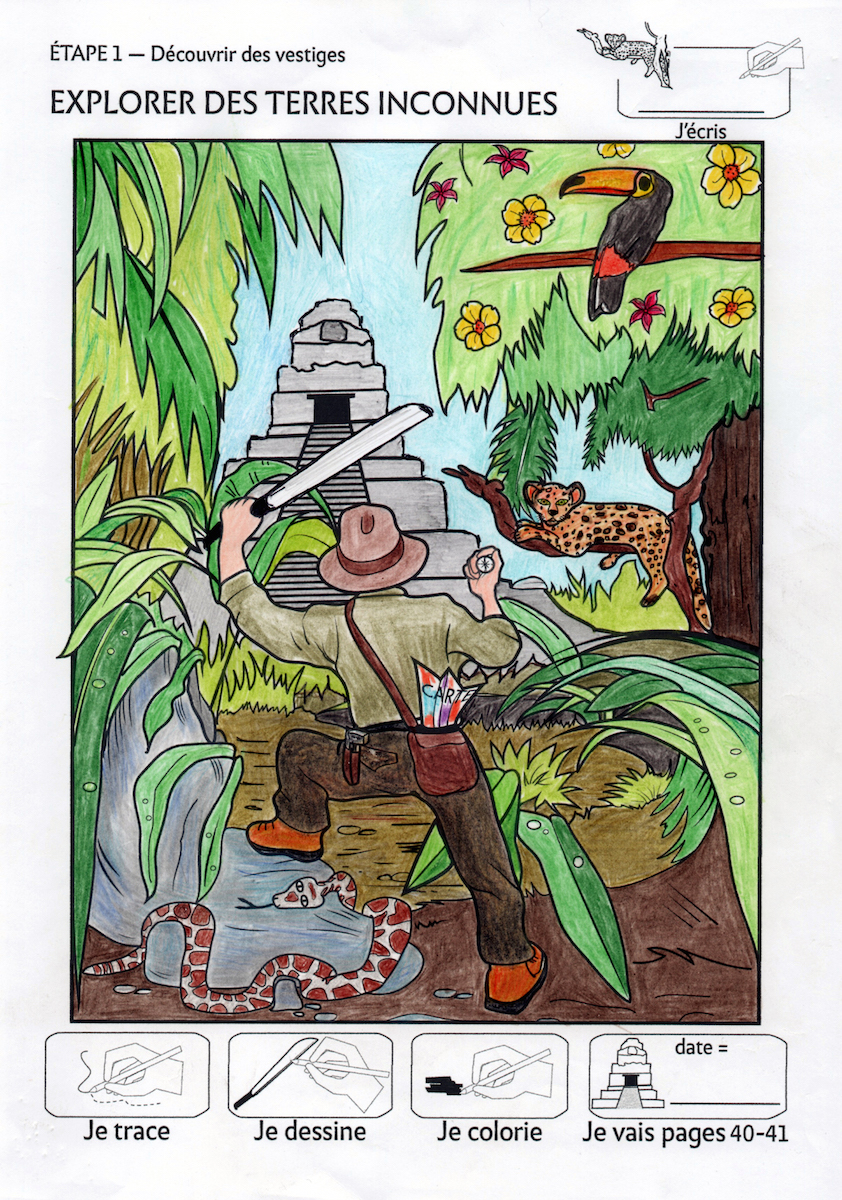
Registered on UNESCO’s World Heritage List since 1979, Tikal was one of the largest urban centers of the pre-Columbian Mayan civilization. The city includes thousands of architectural and artistic remains dating from the Preclassic period (600 BCE) up through the city’s decline and eventual fall around 900 CE. The various ecosystems and habitats surrounding the city are home to a diverse neotropical fauna, including jaguars, which is what Clio, the female jaguar, represents in the book.

Clues
The 10 clues include:
- The dense tropical vegetation
- The temple of Tikal
- Gaspard, the explorer
- The map
- The compass
- The machete
- The gun
- Narco, the snake
- Toccata, the toucan
- Clio, the female jaguar
Clues 4-7 indicate the difficult nature of finding this hidden temple. The drawing illustrates an archaeological discovery made by accident – an accidental or inadvertent discovery – made possible by an adventurer that explores regions that are difficult to access.