contact@arkeotopia.org


Translation by V. Cattane and N. Johnston
From Peyneau to Inrap: 130 years of Research
Around the Arcachon Basin
Much about the Iron Age in the Aquitaine region remains unknown. Indeed, for the Early Iron Age, between 800 and 400 BCE, we know of a number of necropolises but almost no settlements, whereas for the Late Iron Age, (400 to 50 BCE) — the period of Caesar’s conquest of Gaul — we have many settlements, but almost no necropolises.
The Arcachon Bazy is no exception to this pattern. Numerous necropolises have been discovered between Salles and Audenge, but virtually no trace of settlements, with the exception of the occupation sites excavated by Philippe Jacques at the foot of the Dune du Pilat (Jacques 2021) and the submerged village of Put Blanc in Lake Sanguinet, now lying at a depth of 12 meters (Maurin 1998). So far, no discoveries have been reported between Audenge and La Lède du Gurp in Grayan-et-l’Hôpital.
1. Research history
As for necropolises, they have been found since the late 19th century, notably through the work of Bertrand Peyneau, a physician who was mayor of Mios in the early 20th century (Mormone dir. 2022). He excavated a number of sites between Salles, Mios, and Biganos (Peyneau 1926). From the 1930s to the 1970s, archaeological research in the area slowed down, until the publication of the first on Les nécropoles hallstattiennes du bassin d’Arcachon by Jean-Pierre Mohen and André Coffyn (1970), followed in 1980 by Mohen’s doctoral thesis on the Iron Age in the Aquitaine region.
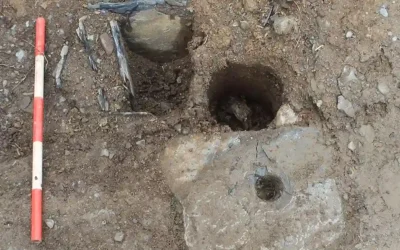
Currently, research focuses on the protohistoric occupation of the Dune du Pilat, notably through the work of Philippe Jacques, fieldwalkings conducted following winter storms, and occasional interventions by the French association Inrap (National Institute for Preventive Archaeological Research). The absence of major construction projects — such as highways or rail lines — has precluded large-scale discoveries, but excavations have taken place in Mios, La Teste-de-Buch, and Audenge, revealing scattered settlements that remain difficult to characterize further. Excavation reports are available through Inrap’s Dolia search engine.
In her master’s thesis and her DEA (a French advanced research degree), Marie-V. Bilbao synthesized research on the subject of burial sites (Bilbao 2005a, 2005b, 2006a, 2006b).
Burial sites fall into two categories: flat-grave necropolises and tumulus necropolises, but in both cases, burial practice involved cremation. This type of funerary rite first appeared in the Late Bronze Age, continuing through to the antiquity period. Burial remained an exceptional practice during this era.
2. Phases of Early Iron Age necropolises
Around a hundred flat graves are currently known, although no necropolis has been fully excavated. This is twice the number of burials beneath tumuli.
These can be organized into necropolises of around ten mounds. Generally, a tumulus is erected for a single cremation, then over time additional funerary urns may be buried within the mound. These may have served as family tombs — the Iron Age equivalent of a family vault.
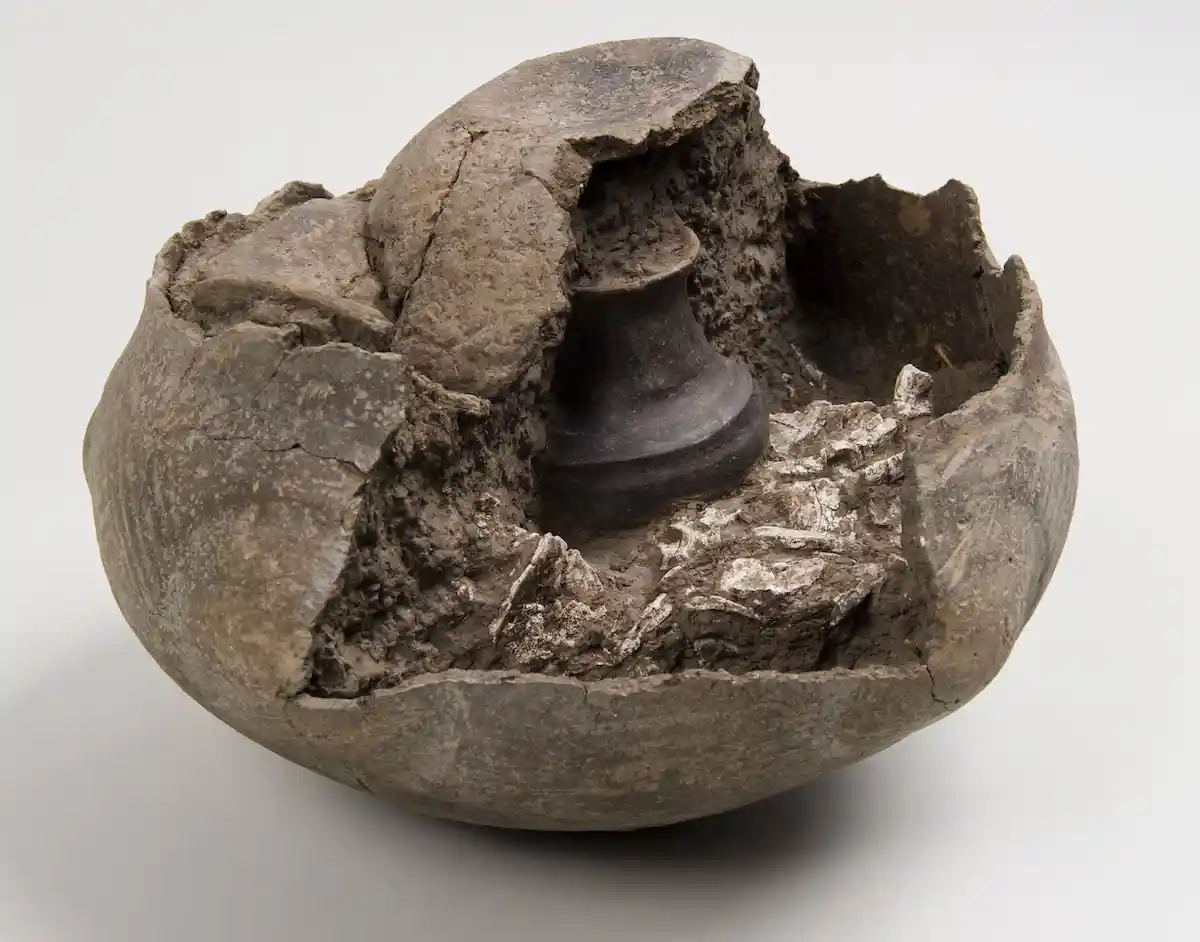
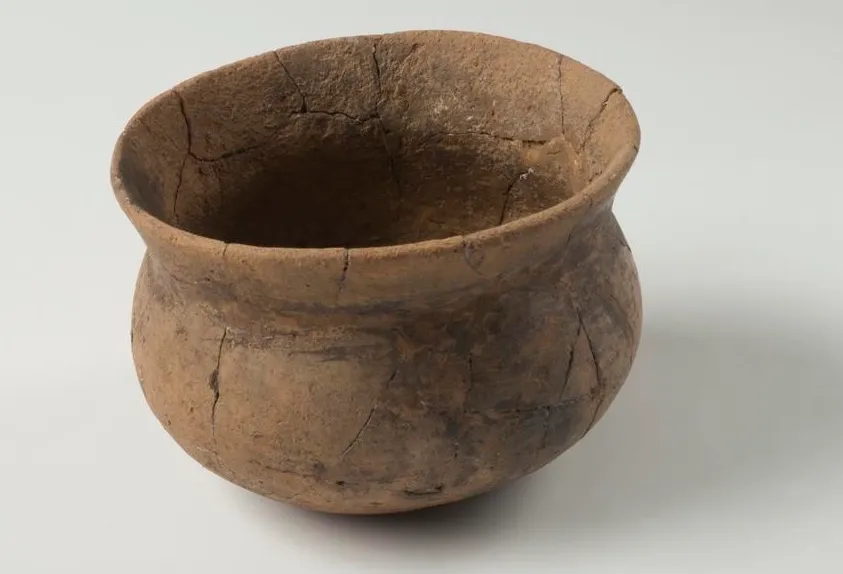
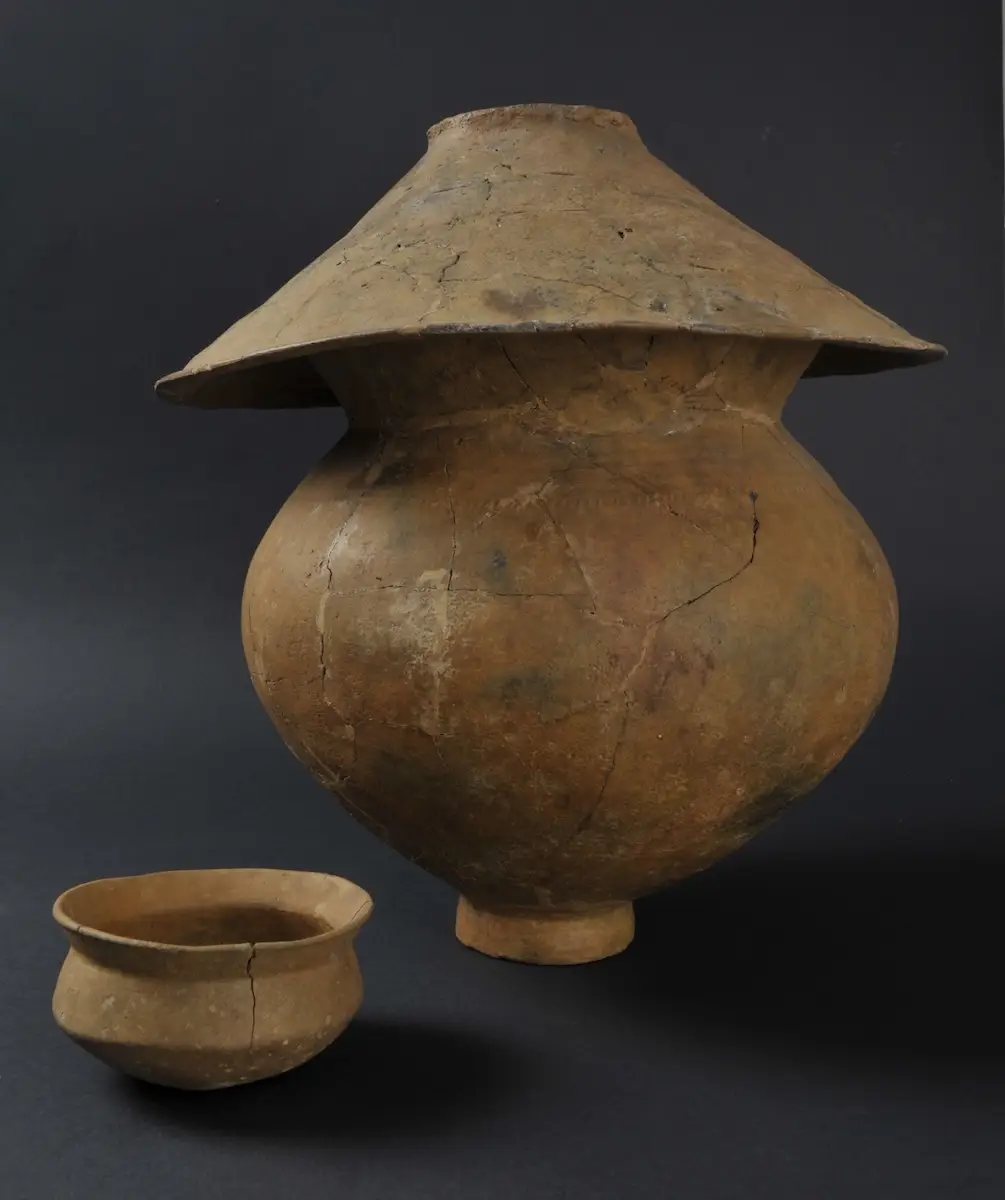
The first phase runs from 800 to 650 BCE. Each funerary assemblage consists of an urn containing the cremated bones of the deceased. This urn, globular in shape with a low foot, is typically covered by a lid-plate sometimes decorated with internal fluting. An accessory vase, placed inside the urn, occasionally accompanies the assemblage. During this time period, metal artifacts were rare.
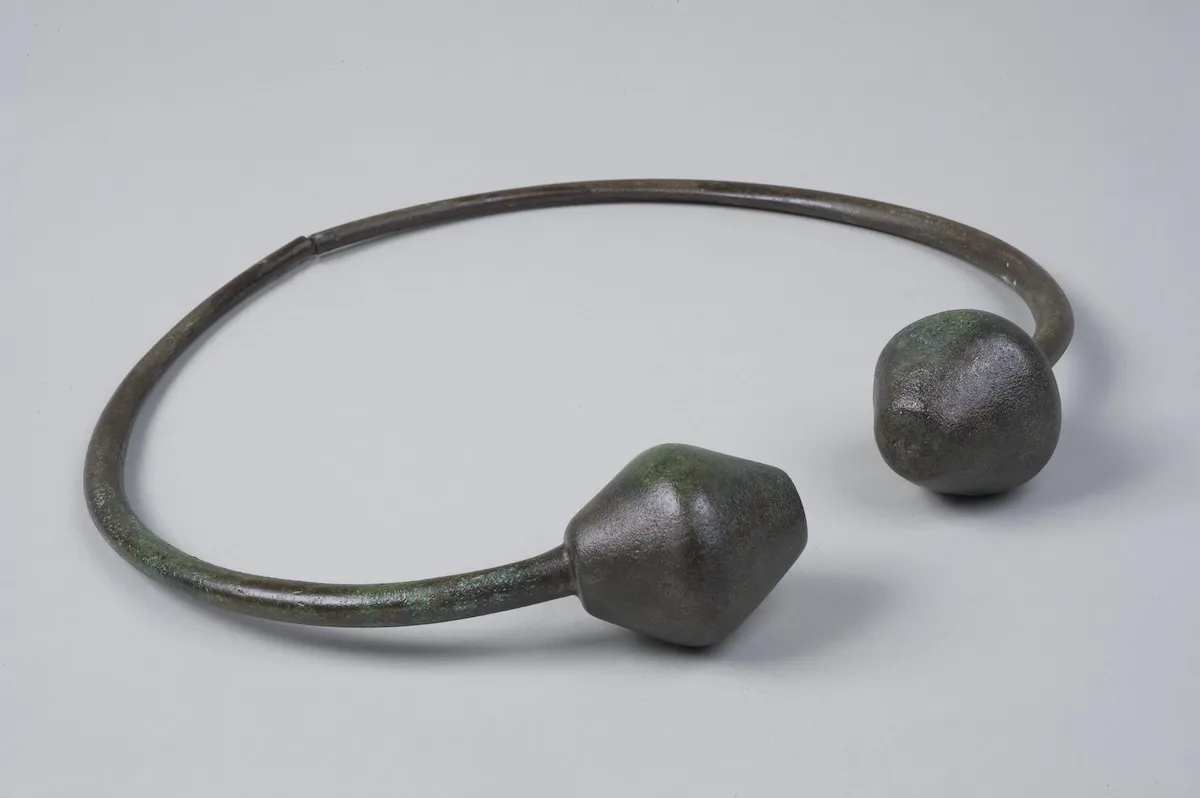
The second phase can be placed between 650 and 520 BCE. The urns are larger in size and lid-plates became rare. Accessory vessels remain present. Metal artifacts are somewhat more frequent and generally take the form of dress ornaments (fibulae) and ring-shaped ornaments (torques and ball-ended bracelets).
The third and final phase is dated from 520 to 430 BCE. This period saw the emergence of warrior burials, generally containing a sword and spear fittings. There is also an increasing complexity in ceramic decoration during this phase.
3. Research Continues
These excavated finds have ended up in varying places. Bertrand Peyneau donated his collections during his lifetime, in 1928, to the town of Arcachon. They joined the Arcachon Museum-Aquarium in 1930. Unfortunately, this museum is currently closed, and its future remains uncertain.
Some excavations from the 1970s and 1980s, notably those conducted by Annie Lesca-Seigne at Le Martinet in Salles and by André Coffyn at the Balanos site in Tech, are preserved and displayed at the Musée d’Aquitaine in Bordeaux.
Philippe Jacques’s more recent excavations at La Teste-de-Buch will be presented in the future Musée de la Teste, while those from Inrap are held in the storage facilities of the Regional Archaeological Services, located on the Certes estate in Audenge.
These collections continue to serve as the basis for new studies. The small vases discovered inside funerary urns have always been found empty. Through proteomics — the study of proteins that may be preserved at the bottom of vases — these objects may soon yield their secrets at the “Bordeaux Protéome” laboratory, directed by Caroline Tokarski, where the accessory vases from the necropolises of Truc de Bourdiou and Le Martinet are scheduled to be studied in 2026 or 2027.
References and notes
Jacques P. (2021) – « La Teste-de-Buch – Dune du Pilat » [notice archéologique], ADLFI. Archéologie de la France – Informations [En ligne], Nouvelle-Aquitaine, mis en ligne le 14 septembre 2021, [EnLigne] http://journals.openedition.org/adlfi/106155
Maurin B. (1998) – 3000 ans sous les eaux : vingt ans de fouilles archéologiques dans le lac de Sanguinet. Gaïa, 122 p.
Mormone J.-M., dir. (2022) – Bertrand Peyneau, archéologue du Bassin d’Arcachon et du Pays de Buch. Société historique et archéologique du Bassin d’Arcachon et du Pays de Buch, 175 p.
Peynaud B. (1926) – Découvertes archéologiques dans le pays de Buch, Tome 1 : depuis l’âge de la pierre jusqu’à la conquête romaine, Bordeaux, 1926.
Mohen, J.-P. et Coffyn A. (1970) – Les nécropoles hallstattiennes du bassin d’Arcachon, Bibliotheca Praehistorica Hispana vol. XI, Madrid, 186 p.
Mohen, J.-P. (1980) – L’âge du Fer en Aquitaine du VIIe au IIIe siècle avant J.-C., Mémoires de la SPF 14, 342 p.
See: Dautant A., Jacques P., Lesca-Seigne A. et Seigne J. (1983) – Découvertes protohistoriques récentes près d’Arcachon (Gironde). Bull. Soc. Préh. Fr. 80/6, p. 188-192 et Roussot-Larroque J. (1994) – L’Âge du Fer en Aquitaine littorale : hommes et milieux naturels. Aquitania 12, p. 13-25.
Bilbao M.-V. (2005a) – Les sépultures du Premier âge du Fer autour du bassin d’Arcachon et de la basse vallée de la Leyre. Mémoire de Maîtrise, Université Michel de Montaigne, Bordeaux III, 3 vol., 190, 75 et 55 p. / Bilbao M.-V. (2005b) – Les sépultures du Premier âge du Fer autour du bassin d’Arcachon et de la basse vallée de la Leyre. Bull. AFEAF 24, p. 18-20. / Bilbao M.-V. (2006a) – Pratiques funéraires au Premier âge du Fer : analyse comparative de part et d’autre des Pyrénées. Mémoire de Master II, Université Michel de Montaigne, Bordeaux III, 147 p. / Bilbao M.-V. (2006b) – Pratiques funéraires au Premier âge du Fer dans le Sud-Ouest de la France : nouvelle approche et perspective d’étude. Aquitania